Friday, August 06, 2010


Wednesday, August 04, 2010
Chainstay Length & Italian Design
If one looks at Italian frame design, something of note is that chainstays are short, and their length varies by frame size. While typical front centers, chainstay lengths, and trail measures vary between De Rosa, Pinarello, and Colnago - the differences aren't great. More importantly, the way these and other design variables change with frame size is very much parallel between these three marques.
Generally, they have shorter chainstays that what I like. This problem with short chainstays has less to do with handling, and more to do with shifting. The cross-over angles of the chain in small/small or big/big gears are more than the systems are made to handle, whether from SRAM, Campy or Shimano.
Before thinking about how your bike is able to shift to the extreme cross-overs, consider riding under full power and what happened to Schleck when his chain dropped. As a rider, you can avoid the extreme combinations, or have longer chainstays (which reduce the angles). I prefer the latter course because there are times when I just don't want to make a front shift - and most other riders seem to feel the same way.
As a conseqence, I'm not likely to copy italian geometry on my frames. But that doesn't mean that there is nothing to be taken away from the designs of these masters. One factor is chainstay length.
In managing front-center, the Italians (and many other builders), seat-tube and head-tube angles vary. While this isn't quite what is happening, imagine a fixed wheelbase, and then pivoting the fork/head-tube at one end and the rear triangle at the other, around their respective wheel axles, to vary the length of the top-tube.
As the frames get bigger, the seat-tube tips further back (the angle becomes shallower). This isn't done to keep kneecaps over the spindle - it's done to distribute rider weight, provide adequate top-tube length, and manage the front-center distance.
In the process, the riders seat (and a significant portion of their weight) moves further backwards above the chainstay, and the seat-tube also comes closer to the rear wheel/tire. Lets look at this a little more closely.
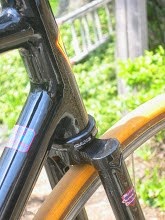
The distance between the seat-tube and rear wheel is a function of the seat-tube angle, bottom bracket drop, and chainstay length. If the seat-tube leans far enough backward, it will rub on the tire. This can be avoided by raising the bottom bracket, lengthening the chainstay, or bending the seat-tube to go around the wheel.
Some builders have choosen, in certain circumstances, to bend the seat-tube. This works, but causes the upper portion of the seat-tube to be at a shallower angle than if the seat-tube was straight. This can cause somewhat extreme changes in fore/aft positioning as the seat is raised/lowered. Hence, I'm among those who consider this a suboptimal solution.
Raising the bottom bracket allows the seat-tube angle to vary without varying the angle between the chainstay and seat-tube - hence ensures clearance for the wheel. But, it does so at the cost of changing the handling feel of a bike. Neither higher or lower is better - but BB position is part of the overall design characteristics which determine how stable/responsive a bike will be. And, for a production model, the goal is to maintain these characteristics across the range of sizes. Therefore, raising the BB for larger frame sizes doesn't make much sense. There are some other factors driving front-center distance and frame rigidity which further argue against raising the BB.
So.... to keep adequate space between the rear wheel and seat-tube, larger frames need longer chainstays. However, there are two more considerations to argue in favor with varying chainstay length with frame size. Otherwise frames that used longer chainstays, wouldn't need to vary the length over size.
First a simple argument: on well designed frames, wheelbase grows with frame size. Front center also grows with frame size. So it makes sense for the chainstay length to also grow in order to maintain appropriate front to rear balance.
Second, as one's seat comes closer to being directly over the rear axle, the ride of ones frame becomes harsher. This has nothing to do with frame stiffness, and everything to do with the geometry of motion, related to going over a bump. If you saddle is squarely over the rear axle, and the rear axle goes over a 1" high bump - then your saddle will rise by 1". If the saddle is half way between the front and rear axles, then it will only rise 1/2" when the rear wheel goes over that 1" bump. While these are extreme postions for the saddle, it shows what a big factor rear wheel versus saddle position really is in determining rider comfort.
Net net, chainstay lengths should vary over frame sizes, and the famous Italian builders demonstrate that every day in their frame designs. Its funny, isn't it, how complicated one little measurement can be in determing the overall ride characteristics of a bicycle.
Generally, they have shorter chainstays that what I like. This problem with short chainstays has less to do with handling, and more to do with shifting. The cross-over angles of the chain in small/small or big/big gears are more than the systems are made to handle, whether from SRAM, Campy or Shimano.
Before thinking about how your bike is able to shift to the extreme cross-overs, consider riding under full power and what happened to Schleck when his chain dropped. As a rider, you can avoid the extreme combinations, or have longer chainstays (which reduce the angles). I prefer the latter course because there are times when I just don't want to make a front shift - and most other riders seem to feel the same way.
As a conseqence, I'm not likely to copy italian geometry on my frames. But that doesn't mean that there is nothing to be taken away from the designs of these masters. One factor is chainstay length.
In managing front-center, the Italians (and many other builders), seat-tube and head-tube angles vary. While this isn't quite what is happening, imagine a fixed wheelbase, and then pivoting the fork/head-tube at one end and the rear triangle at the other, around their respective wheel axles, to vary the length of the top-tube.
As the frames get bigger, the seat-tube tips further back (the angle becomes shallower). This isn't done to keep kneecaps over the spindle - it's done to distribute rider weight, provide adequate top-tube length, and manage the front-center distance.
In the process, the riders seat (and a significant portion of their weight) moves further backwards above the chainstay, and the seat-tube also comes closer to the rear wheel/tire. Lets look at this a little more closely.
The distance between the seat-tube and rear wheel is a function of the seat-tube angle, bottom bracket drop, and chainstay length. If the seat-tube leans far enough backward, it will rub on the tire. This can be avoided by raising the bottom bracket, lengthening the chainstay, or bending the seat-tube to go around the wheel.
Some builders have choosen, in certain circumstances, to bend the seat-tube. This works, but causes the upper portion of the seat-tube to be at a shallower angle than if the seat-tube was straight. This can cause somewhat extreme changes in fore/aft positioning as the seat is raised/lowered. Hence, I'm among those who consider this a suboptimal solution.
Raising the bottom bracket allows the seat-tube angle to vary without varying the angle between the chainstay and seat-tube - hence ensures clearance for the wheel. But, it does so at the cost of changing the handling feel of a bike. Neither higher or lower is better - but BB position is part of the overall design characteristics which determine how stable/responsive a bike will be. And, for a production model, the goal is to maintain these characteristics across the range of sizes. Therefore, raising the BB for larger frame sizes doesn't make much sense. There are some other factors driving front-center distance and frame rigidity which further argue against raising the BB.
So.... to keep adequate space between the rear wheel and seat-tube, larger frames need longer chainstays. However, there are two more considerations to argue in favor with varying chainstay length with frame size. Otherwise frames that used longer chainstays, wouldn't need to vary the length over size.
First a simple argument: on well designed frames, wheelbase grows with frame size. Front center also grows with frame size. So it makes sense for the chainstay length to also grow in order to maintain appropriate front to rear balance.
Second, as one's seat comes closer to being directly over the rear axle, the ride of ones frame becomes harsher. This has nothing to do with frame stiffness, and everything to do with the geometry of motion, related to going over a bump. If you saddle is squarely over the rear axle, and the rear axle goes over a 1" high bump - then your saddle will rise by 1". If the saddle is half way between the front and rear axles, then it will only rise 1/2" when the rear wheel goes over that 1" bump. While these are extreme postions for the saddle, it shows what a big factor rear wheel versus saddle position really is in determining rider comfort.
Net net, chainstay lengths should vary over frame sizes, and the famous Italian builders demonstrate that every day in their frame designs. Its funny, isn't it, how complicated one little measurement can be in determing the overall ride characteristics of a bicycle.
Tuesday, August 03, 2010
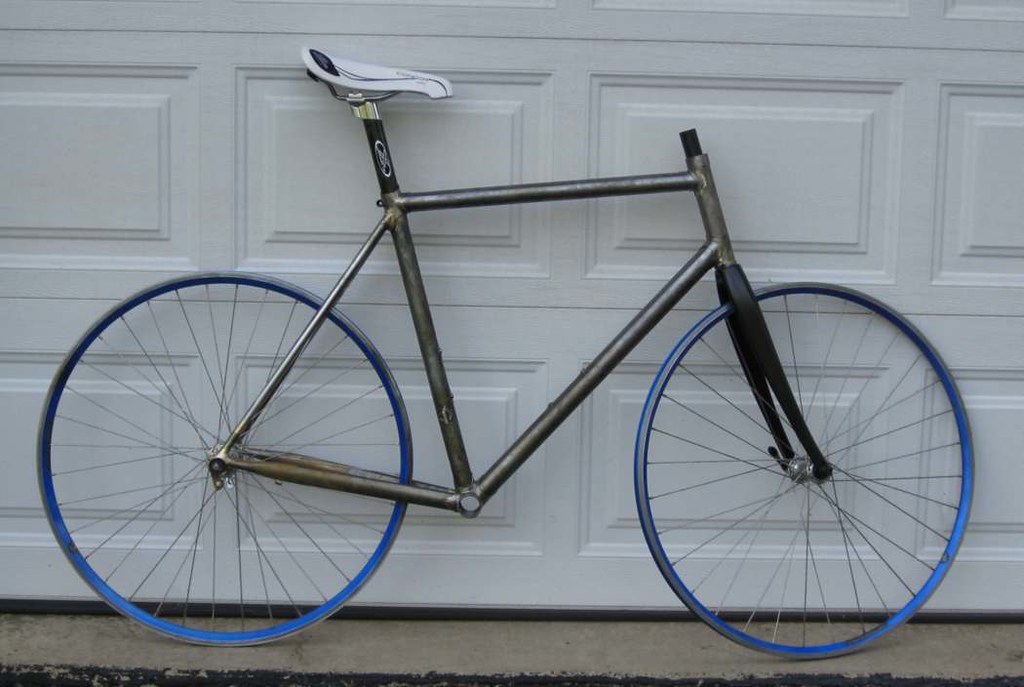
New Photo
If you're a faithful reader, you know that I'm photo-challenged. But here is one shot of a bike that's nearing completion. It still needs a brake bridge, cleanup and paint.

After completing the stays, I put the alignment tools on the drops. By their design, they don't allow much (if any) bending to ensure parallelism. I was gratified to see that they were spot on. The test wheel drops right in and looks straight from all angles. Good stuff.
More soon.

After completing the stays, I put the alignment tools on the drops. By their design, they don't allow much (if any) bending to ensure parallelism. I was gratified to see that they were spot on. The test wheel drops right in and looks straight from all angles. Good stuff.
More soon.
Monday, August 02, 2010
SRAM RED LTE (that means yellow)
For an extremely limited time, the Force red group is available at LTE (Limited Tour Edition). The silver parts are anodized black, and the color red logoing becomes yellow* (like the leader jersey). You may have noticed this group on the leaders bikes during the Tour de France.
Contact me immediately if you want in. Cost for a full group is $2400. Individual parts not available. BB30 adds $35 to the price, a clamp-on front derailer (31.7 or 35mm) adds $25 to the price.
Be the only kid on your block with the gear that won the Tour de France!
Contact me immediately if you want in. Cost for a full group is $2400. Individual parts not available. BB30 adds $35 to the price, a clamp-on front derailer (31.7 or 35mm) adds $25 to the price.
Be the only kid on your block with the gear that won the Tour de France!
Thursday, July 29, 2010
Everything you wanted to know....
About Framebuilders!
Velocipedesalon.com is a great community for anyone who loves bikes and biking. It's also home to "Smoked Out" where various custom builders maintain threads about themselves and their work, and you can post questions and get feedback! There's nothing else like it in the world.
Currently, the headliner is Nick Crumpton who is famous for his custom carbon frames. You can find him at www.Velcipedesalon.com/forum.
If you'd like to see all the builders threads, just go to http://www.velocipedesalon.com/forum/f22/
Remember you heard it hear first!
Velocipedesalon.com is a great community for anyone who loves bikes and biking. It's also home to "Smoked Out" where various custom builders maintain threads about themselves and their work, and you can post questions and get feedback! There's nothing else like it in the world.
Currently, the headliner is Nick Crumpton who is famous for his custom carbon frames. You can find him at www.Velcipedesalon.com/forum.
If you'd like to see all the builders threads, just go to http://www.velocipedesalon.com/forum/f22/
Remember you heard it hear first!
Tuesday, July 27, 2010
Checking In
I'm almost done creating an odd format racer. It's taken lots of thinking, but I think its dialed in correctly.
By odd format, I'm referring to the fact that the seat height is 770mm, w/ a 520mm effective toptube. It's a big short bike - to fit a long legged rider with limited reach. The drop is about 3.5 inches, so that's not a problem - just limited material between his hips and shoulders.
So how would you design this frame? Note that the rider does road races and crits in souther CA (although he's currently on his way over to ride the Stelvio). He likes both, and is probably best at the crits - he doesn't have a classic climbers build. On the other hand, he seems to put out pretty good watts - and can sprint pretty hard.
Based on power, weight and height, I chose a 2X oversized steel tube frame. 35mm downtube, 31.7mm seat and top tubes, 36mm headtube. All fairly light, but large diameter and stiff. The rear triangle is similar - and looks strong.
Unlike bike manufacturers, I have the luxury of building chainstays to the length I chose, not what's fashionable. While short, the chainstays are 410mm - the minimum I think will offer good shifting over the range of gears. Let's face it, everyone ends up in cross-over gears sometimes, and for races that may be even more true as they need to be selective about when to do a double (front and back) shift.
The BB drop is about 70mm, but I don't think it would make much difference if it were 65 or 75 mm. The 70mm, combined with a 6 degree sloping top tube will make sure he has comfortable top-tube clearance.
I don't like lots of spacers topped with an upward pointed stem - it doesn't look pro. So he has a long headtube (about 175, plus a conventional threadless headset). If needed, he can about a centimeter off the headtube - but this is computed to work with his preferred drop and and a downward (relative) pointing stem.
But the real key to all of this is front end geometry. Depending on the source, there is a limited range of appropriate trail and/or head-angle and/or rake. Others maintian front center distance is the critical element to handling. Most all hold that different head-angles require different trial numbers. But some emphasize widely varying trail via a constant rake, while others insist that's poor design and adjust rake to limit the range of trail figures. And some limit the range of head-angles to avoid this question.
My rider excels at crits, but has to ride some very technical descents in the LA area. So, stability and predictability trump quickness for his front end. Some builders argue that there's shouldn't be a difference between a crit and road course bike. I won't go so far. I'll say that one bike can be good at both, but that the disciplines do push different handling dynamics. Moreover, the kings of road course design are (IMO) the Italians. That doesn't mean a Pinarello can't compete well at a crit, just that I expect it to be at its best on a road course.
I didn't want the front center squished by the short top-tube. Which means that the head-tube has a relatively shallow angle. That's a given to keep the fundemental handling solid. But where I originally was thinking of a longer rake to manage the trail, I've looked closely a Colnagos, De Rosas, and Pinarellos, and how they handle a similar front end. Based on this, the fork will have 43mm of rake - which is leading to lots of trail - which should give that stable, predictable, handling on descents. And it'll still be a great crit bike.
So it's back to the frame - which still needs a brake-bridge and chain-stay bridge before its cleaned up and painted. Hope to have some pix soon.
By odd format, I'm referring to the fact that the seat height is 770mm, w/ a 520mm effective toptube. It's a big short bike - to fit a long legged rider with limited reach. The drop is about 3.5 inches, so that's not a problem - just limited material between his hips and shoulders.
So how would you design this frame? Note that the rider does road races and crits in souther CA (although he's currently on his way over to ride the Stelvio). He likes both, and is probably best at the crits - he doesn't have a classic climbers build. On the other hand, he seems to put out pretty good watts - and can sprint pretty hard.
Based on power, weight and height, I chose a 2X oversized steel tube frame. 35mm downtube, 31.7mm seat and top tubes, 36mm headtube. All fairly light, but large diameter and stiff. The rear triangle is similar - and looks strong.
Unlike bike manufacturers, I have the luxury of building chainstays to the length I chose, not what's fashionable. While short, the chainstays are 410mm - the minimum I think will offer good shifting over the range of gears. Let's face it, everyone ends up in cross-over gears sometimes, and for races that may be even more true as they need to be selective about when to do a double (front and back) shift.
The BB drop is about 70mm, but I don't think it would make much difference if it were 65 or 75 mm. The 70mm, combined with a 6 degree sloping top tube will make sure he has comfortable top-tube clearance.
I don't like lots of spacers topped with an upward pointed stem - it doesn't look pro. So he has a long headtube (about 175, plus a conventional threadless headset). If needed, he can about a centimeter off the headtube - but this is computed to work with his preferred drop and and a downward (relative) pointing stem.
But the real key to all of this is front end geometry. Depending on the source, there is a limited range of appropriate trail and/or head-angle and/or rake. Others maintian front center distance is the critical element to handling. Most all hold that different head-angles require different trial numbers. But some emphasize widely varying trail via a constant rake, while others insist that's poor design and adjust rake to limit the range of trail figures. And some limit the range of head-angles to avoid this question.
My rider excels at crits, but has to ride some very technical descents in the LA area. So, stability and predictability trump quickness for his front end. Some builders argue that there's shouldn't be a difference between a crit and road course bike. I won't go so far. I'll say that one bike can be good at both, but that the disciplines do push different handling dynamics. Moreover, the kings of road course design are (IMO) the Italians. That doesn't mean a Pinarello can't compete well at a crit, just that I expect it to be at its best on a road course.
I didn't want the front center squished by the short top-tube. Which means that the head-tube has a relatively shallow angle. That's a given to keep the fundemental handling solid. But where I originally was thinking of a longer rake to manage the trail, I've looked closely a Colnagos, De Rosas, and Pinarellos, and how they handle a similar front end. Based on this, the fork will have 43mm of rake - which is leading to lots of trail - which should give that stable, predictable, handling on descents. And it'll still be a great crit bike.
So it's back to the frame - which still needs a brake-bridge and chain-stay bridge before its cleaned up and painted. Hope to have some pix soon.
Thursday, May 20, 2010


Tuesday, May 11, 2010
Friday, April 23, 2010


Thursday, April 22, 2010


Subscribe to:
Posts (Atom)