Thursday, April 28, 2005

Slipping Slipping into the Future

Time is truly a frustration of late, it just slips away. That's really a good problem, it means work is busy and the kids won't have to go hungry.

Last weekend (can it be Thursday already?) I did a couple of filleted joints on a work stand I'm making. They weren't bike quality but were the first time I've had any real success with Low Fuming Bronze. It felt good to turn them out in fairly short order and be ready to attack the next step in building this stand.

This week should be anvil shopping and practice lugged joints (along with painting some new closet doors for my daughter's room). That will keep me busy.

I tend to be a supporter of the Post Office and it's employees. So I ordered a few Cyclus tools and a pair of Mafac brakes from renaissance in Holland. No one was home when the first package arrived on Friday so they left me a slip. Saturday I went to the post office to pick it up, but they couldn't find it. They took my number but didn't call back. Monday I went to the post office and they still couldn't find it, so I asked to file a claim. No can do! Not without waiting 10 days. I asked why and was told that I didn't know the package was lost. Let's see, they tried to deliver it - so we know they had it. They didn't deliver it but don't know where it is. So how can it be anything but lost? Well, they told me that it might have been sent to the regional distribution center by accident. How long should it take to come back? One to two days. Hmmm? Well I still haven't seen it, but my second order arrived. I guess I'll try again at the post office, but I wish that renaissance used DHL or FedEx.

It's been a while since I handled Mafac brakes, they feel good. It's hard to decide whether to use them natural, or to polish them to a real finish. Anyhow, I should have ordered the version that came with levers; the original plan was to use a flat bar but now a drop seems more likely. Maybe I'll order a pair or two with levers just to have the inventory.

That's all for now folks.


Wednesday, April 20, 2005

Time Away

It's been since Saturday that I last touched a tube and it feels like an itch I can't scratch. It's been a busy few days, between work and and extra-curricular activities. No complaints re either, but they haven't left me time to go into the shop.

Last night I was volunteering in the Kitchen at the Curling Club. Its our annual meeting and dinner, after which the season is officially over. That's probably good because curling doesn't wear off the pounds like riding. I've become big this last winter. And, I don't mean famous.

Tonight I'll be going to a Captains Meeting for the MS150. The Illinois Chapter of the Multiple Sclerosis Society uses this ride as their biggest fund-raiser for the year. This is my third year participating and my second as a sort of junior-assistant captain of the Wheeler Dealers. Traditionally we raise the largest total dollars of all the teams, but a couple of other teams are now nipping at our heels. This could be the year we get knocked off our pedestal (that's a good problem).

Chad Smith is the Captain of my team (he's also the guy in the bright jersey pictured with me). He's a good guy and his wife is a real sweety. A few years back Trish got diagnosised with the progressive form of MS (this is a form which only gets worse rather than having remissions). In spite of this, she's an upbeat, friendly, charming gal. So having got connected to she and Chad as part of my first Tour de Farms (MS150), there's no turning back.

Anyway, there's a team captains meeting this evening which Chad can't attend, so I'll sub for him. I've attended these before, and it will be a lot of fun, even though we have some serious work to accomplish.

By the way, if anyone would like to help me reach my fundraising goals, click on the link which will take you to my MS150 page where you can learn more and contribute. Any and all contributions are appreciated, go to a good cause, and are efficiently spent.

This gap in my work may be good. It gives my respirator and lug pins time to arrive - both of which should help me to work better. I've also been discussing technique with a few folks off-line, and have some new tricks to try.

It's time to move on to some other work, so I'll end this here.


Monday, April 18, 2005

Twisted Tubes

I've been mulling over my cut apart joints, also the pictures that Suzy Jackson has shared of her cut apart bottom bracket.

Silver can fit into some tight spaces. Heat is key, but so is knowing where to put it. I'm probably going to try a tip one size down from my 153 (2.2mm), with as big a flame as possible. I want to see if the tip size can concentrate the flame, or if it only limits the size of flame possible.

The review of my lugged joint shows how much the one tube shifted, and its impact on filling the joint. Not good. Once things are fluxed up, its hard to see where the tube should sit. I think that when my pins arrive, I'll be able to better control this and get much better joints.

Apart from this, I'm not very concerned about my filling at this time. I have a problems with excess filler dripping down the tubes and cluttering the lug edges. In terms of strength and safety, this seems like a preferable problem to underfilled lugs.

The more I work, the more apparent it is that my vice needs to be moved. I like its position for filing, and its firmly supported. But, its too hard to work on both sides of a joint when brazing. One possibility is to cantilever the vice away from the work bench, but it seems likely to make the vice less steady. Another is to make a separate stand for the vice and position it in a more convenient postition. Maybe this weekend I can try making a stand.

Meanwhile, I need to miter a few more tubes and practice some more fillets on my workstand.

That's all for now.


Saturday, April 16, 2005


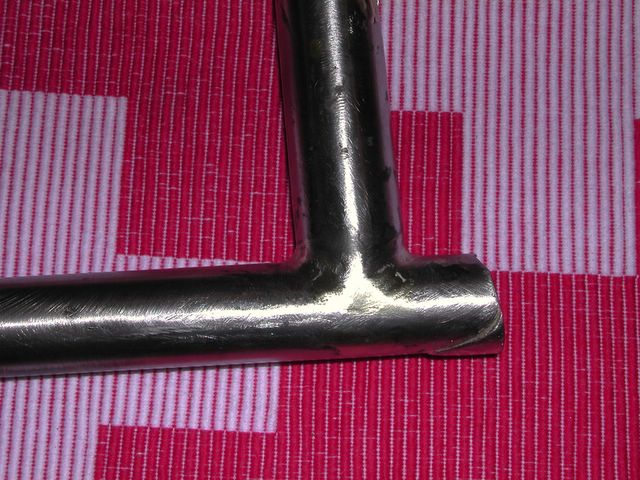
Here you can see the nice radius on right and left but in the center there's merely a transition from the diameter of the mitered tube to that of the main tube.
Copyright R. Guggemos

Fillets this Time.

I had some time today, so I decided to try another fillet joint and then cut it up - pictures are below.

Before going farther, lets describe fillet and lugged joints, in one paragraph, for those who may not know the difference. There are two ways of brazing tubes together to make bicycle frame. Brazing, by the way, is essentially a process of gluing together a couple of tubes where the glue is a metal that melts at a lower temprature than that of the tubes - the idea is to avoid overheating the tubes and thereby changing their mechanical properties. Many brazed frames are built with lugs. A lug is a metal piece that has a circular opening for each of the tubes being joined. It completely covers the area where the tubes meet, and covers some amount of additional real estate on each tube. The lug itself doesn't hold the tubes together (that's done with the brazing material), however it may impart some additional strength and/or stiffenss to the joint. Lugs can be big or small (click on the link to the left for Strawberry Cycles and see how small a lug Andy Newlands is able to produce). Lugs are often decorated either by carving (shaping) them in pleasing way (including putting holes of different shapes through them), or by painting them, or (in the case of stainless steel lugs) by polishing them to a chrome-like luster. The alternative is to work without a lug. In this case a fillet (pronounced fill-it) of bronze is built up between the two tubes. This is filed to a pleasing radius (which may be big or small depending on a host of variables). In the process, a fillet should be formed on the inside of the tubes as well. A fine line of bronze runs between the two tubes (where they meet) and bridges the inner and outer fillets. In this way, the joining tube is encapsulated with bronze for a strong joint.

Working with bronze, I seem to fear the heat some; which was part of my focus today. Starting with the biggest flame available on the 153 tip at 10lbs O2 and 7 lbs propane, I also adjusted it more towards neutral than carborizing. This seems like the right way to get things hot enough for the bronze. I also explored using the side of the flame some of the time. Instead of pointing the flame directly at the rod, I'd run the flame almost parallel to the tubes. This way it was possible to to get a large area very hot (after pre-heating) and edge the hottest part into the rod without seeming to burn the flux so badly. Mostly this worked well where I could reach the work this way.

One thing that isn't clear to me is how useful or even important it is to have the joint suspended in a way that it can be turned upside down and spun from right to left while building the fillet joint. I'm working from an aluminum armature held in my vice to which the two tubes are clamped. As such, its hard to move things around. I had to do some moving because the vice is connected to the corner of the workbench. Certain angles just aren't accessible to work the flame. Anyhow, I may try clamping the armature into my bike stand next and see if the added flexibility helps.

I did one dumb thing with todays joint. I mitered a larger diameter tube to a smaller diameter tube. This results in a pair of ears that extend beyond the outer circumference of the smaller tube. The difference in tube diameters is small (0.125"), but this is enough to make the joint much harder to execute well as you can see in the pictures below. I was also using a strong rod, but one which tends to be more liquid when melted and consequently forms a narrower fillet. This tends to excacerbate the problems caused by the tube sizes I chose.

Looking below, there are a couple of key findings: 1) the inner fillet is large and encircles the joint giving strength all the way around (I used the trick of placing a circle of rod inside the tube before the joint is assembled); 2) where the miter touches the main tube, a nice fine fillet formed which files to a pleasing radius; 3) where the miter gaps from the tube, the fillet only forms a nice transition between the tube, leading to a less strong joint.

My summary, I'm getting closer to being able to create functional joints either with lugs of filleted, but still need some improvement. I'm going to try a couple more head-lugs and then move to practicing on a BB. These will all get cut up to determine if that improvement is occuring, or if I need to keep at it.

Cheers

Here you can see that the mitered tube (1.125") is bigger around than the main tube (1.0"). As always you can click the picture to enlarge it for a better view.
Copyright R. Guggemos

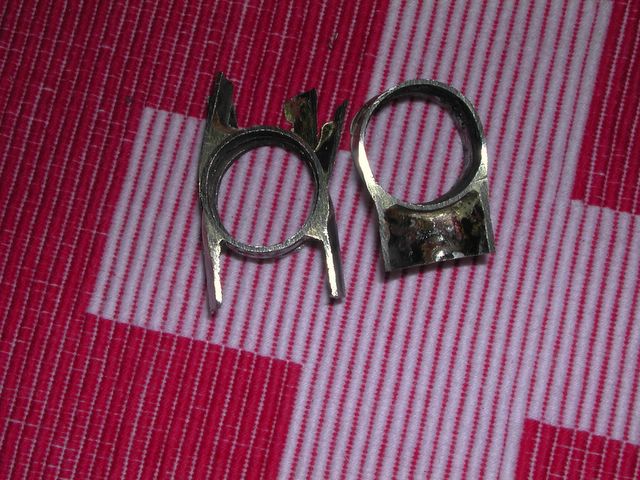
The interior view of the joint. Fillet all the way around, but a bit heavy on the Bronze on the right side.
Copyright R. Guggemos

Top layer showing a nice internal fillet and adequate encapsulation of the miter.
Copyright R. Guggemos

2nd Layer showign the transition away from full encapsulation of the miter.
Copyright R. Guggemos

Here's the bottom layer.
Copyright R. Guggemos